


Osteoarthritis (Greek: arthr) is a group of diseases that damage the joints of the human body.
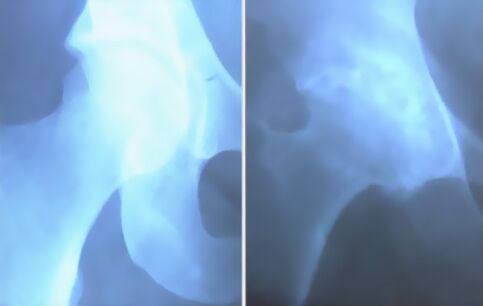
The left side of the photo of a healthy person.On the right, a person suffering from severe osteoarthritis of the right hip joint.We see that the channel is completely closed.Severe pain occurs and the patient cannot get up.
There are more than 100 different forms of osteoarthritis.The most common form, osteoarthritis (damage to the joint ends of the articulating bones), is the result of joint trauma, joint infection, or age-related factors.
Other forms of osteoarthritis include rheumatoid arthritis (rheumatism), gout, psoriatic osteoarthritis, and related autoimmune diseases.Septic osteoarthritis is caused by a joint infection.All forms have a common symptom: joint pain.
Symptoms
All types of osteoarthritis are accompanied by pain, the nature of which determines its type.Characterized by redness of the skin, limited mobility of the knee joint and changes in its shape.Disease-prone joints often crack abnormally when stressed.The patient may experience difficulty in cases where it is necessary to engage in physical activity.
The elements of the medical history determine the diagnosis.The important elements are the time of onset and the speed of progression of the disease, the presence of morning immobility, pain, “blocking” of the joint due to inactivity, etc.For a more accurate diagnosis, radiography and tomography are used.
Causes of osteoarthritis
Osteoarthritis pain is caused by inflammation that occurs around the joint.Joint damage due to illness, daily friction, muscle tension.Joint pain is often constant.The pain may be localized in the affected areas.
Classification of osteoarthritis
Osteoarthritis is divided into primary and secondary.There are 4 degrees of osteoarthritis:
Osteoarthritis of the knee joint 1st degree - softening of the cartilage appears, can be felt on the surface of the knee.Not visible on x-ray.
Osteoarthritis of the knee joint 2nd degree - the cartilage begins to wear out and in the photo you can see a narrowing of the joint space.
Osteoarthritis of the knee joint 3rd degree - osteophytes appear, treatment is more difficult.Difficult to distinguish from the 2nd degree.
Osteoarthritis of the knee joint 4 degrees - the bones come into contact with each other, osteophytes increase and distortion of the joint occurs.
Osteoarthritis of the patellofemoral joint
Patellofemoral osteoarthritis is a lesion of the cartilage located between the kneecap and the femur.Unlike other types of knee osteoarthritis, which occur on the inside (medial) and outside (lateral) of the knee and cause difficulty walking on flat surfaces, patellofemoral osteoarthritis causes pain in the front of the knee when squatting and rising from a sitting position.In this case, a knee brace helps a lot.Patients who wore the brace daily had significantly less joint damage on MRI and reduced knee pain.
Prevention and treatment of osteoarthritis of the knee joint
Osteoarthritis, like rheumatoid arthritis, cannot be completely cured without surgery, but steps can be taken to prevent the condition from getting worse.Weight measurement is essential to improve symptoms and prevent disease progression.For osteoarthritis, physiotherapy is indicated to strengthen the muscles and joints.ESMA equipment is particularly effective for its treatment.Patients also require drug treatment.When the disease progresses quickly and the pain is constant, surgical intervention may be offered.Unlike rheumatoid arthritis, osteoarthritis benefits from joint replacement for many people.There are synovial injections - intra-articular fluid injections.They allow the patient to be relieved of pain for 8 months, after which the procedure is repeated.Bee venom treatment is also effective in relieving pain.
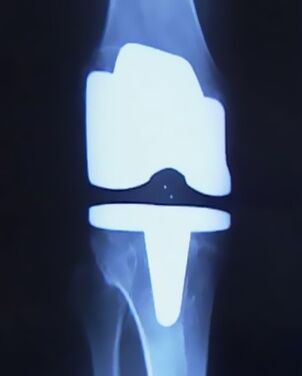
X-ray of a knee with an artificial prosthesis after arthroplasty.
Osteoarthritis prevention
Includes a set of procedures: massage, hydrotherapy, physiotherapy, herbal preparations, dietary supplements, aromatherapy, heat and cold treatment, health exercises, diet.
According to statistics, more than 43 million Americans today experience pain when bending their knees.According to statistics, it is one of the leading causes of disability in the country.About 1 in 7 Americans suffer from it.With age, the risk of developing osteoarthritis increases.